For many education businesses, growth eventually runs into the same wall: the tools that worked when the company was small start to break down once student numbers, course formats, and administrative tasks multiply. That was exactly the situation eBLOCK and Odoo eventually helped solve, making it a valuable case study for any training provider or service business wondering whether it’s time to move beyond spreadsheets and adopt a centralized ERP system.
eBLOCK Formación is an online education platform focused on exam and degree preparation. It offers civil service exam coaching and university-level courses through a mix of live online classes, pre-recorded lessons, and flexible learning formats that fit around students’ jobs and daily routines. According to the company’s official case study, it built its reputation on delivering high-quality, flexible education. However, before eBLOCK and Odoo came together, that same flexibility wasn’t reflected in the company’s internal operations, which still relied on manual processes and disconnected spreadsheets. The success of eBLOCK and Odoo shows how the right ERP strategy can simplify complex educational operations while creating a scalable foundation for long-term business growth.
Life Before Odoo: Spreadsheets, No Website, No Traceability
Three years before adopting Odoo, eBLOCK had no centralized system at all. The entire business student records, course tracking, finances was managed manually in Excel. There was no website and no online store, which made it difficult to expand course offerings or sell new programs at scale. Customer management was slow and fragmented, with no reliable way to trace a prospective student’s journey from inquiry to enrollment. Accounting was handled the same way: spreadsheet by spreadsheet, with no real-time visibility into the company’s financial position.
This is a familiar pattern. Plenty of small businesses hit a point where manual processes start actively limiting growth rather than just being inconvenient. If that sounds familiar, it’s worth reading more about transforming a small business workflow with Odoo ERP, since eBLOCK’s starting point is close to where many growing service businesses find themselves. This early stage highlights why eBLOCK and Odoo became the turning point for replacing manual processes with a connected digital ecosystem.
Why Education Businesses Are Digitizing Right Now
eBLOCK’s move wasn’t an isolated decision it reflects a broader shift happening across the education sector. UNESCO’s work on digital learning and the transformation of education highlights how technology adoption in education has accelerated sharply in recent years, with institutions and training providers increasingly expected to operate with the same digital infrastructure as any modern business websites, online payment systems, traceable customer data, and centralized reporting. For an exam-prep and degree-course provider like eBLOCK, staying competitive meant treating its back office with the same seriousness as its course content. For organizations planning sustainable growth, the eBLOCK and Odoo journey proves that digital transformation is no longer optional but a competitive necessity.
A Phased Implementation, Not a Big Bang
Rather than attempting to digitize everything at once, eBLOCK worked closely with its Odoo implementation partner, WaysIt, to build a step-by-step Odoo implementation roadmap. The partner defined the rollout timeline and scheduled training sessions so staff could adapt gradually rather than being thrown into a brand-new system overnight.
The first modules to go live were accounting and sales the two areas causing the most pain. Once those were stable, the implementation expanded outward, with each stage paired with hands-on training for employees. This guided, partner-led approach is exactly why working with the right Odoo partner matters as much as the software itself; a good partner sets realistic milestones instead of pushing for a disruptive all-at-once switch. Rather than disrupting daily operations, eBLOCK and Odoo demonstrate how gradual implementation helps teams adopt new technology with greater confidence.
Connecting the Pieces: Website, Store, Accounting, and CRM
One of eBLOCK’s core needs was tying together systems that had previously existed in isolation or hadn’t existed at all. With Odoo, the company finally had a website and an online store to sell courses directly, alongside a connected accounting system that replaced its old spreadsheets. Just as importantly, customer management became centralized: instead of tracking prospective students through scattered files, eBLOCK gained a single, traceable view of leads, enrollments, and accounts.
This kind of unification is precisely what Odoo integration services are built for connecting a company’s website, sales channels, and financial systems so information doesn’t have to be re-entered or reconciled by hand across multiple tools. The integration achieved through eBLOCK and Odoo eliminated duplicate work and gave every department access to accurate, real-time business information.
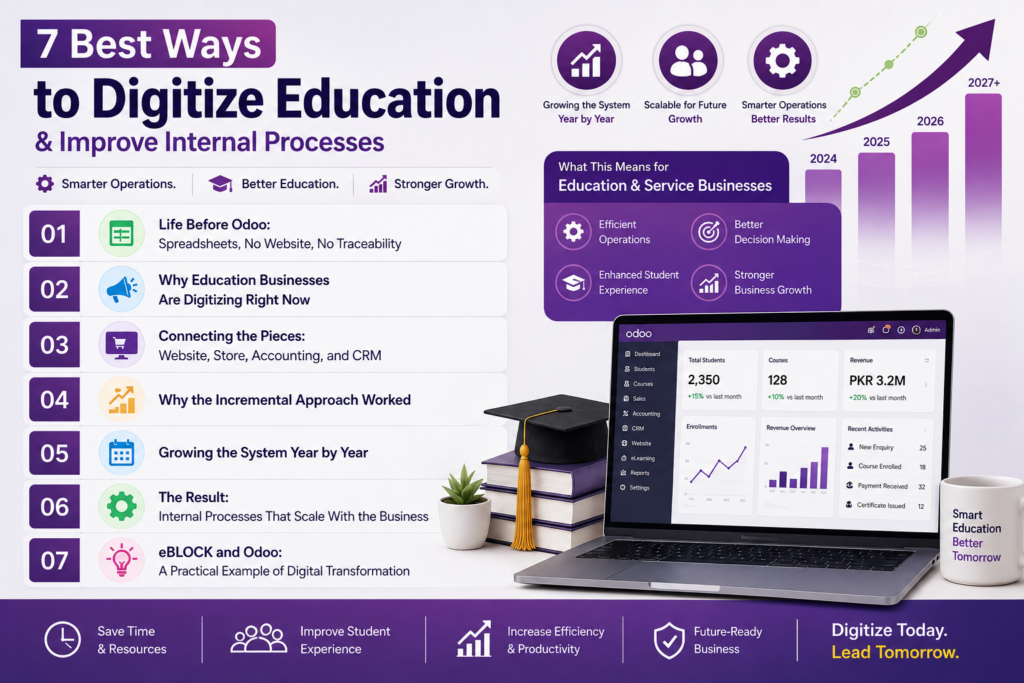
Why the Incremental Approach Worked
eBLOCK’s gradual, training-supported rollout isn’t just a nice-to-have it’s backed by data on what actually makes digital transformations succeed. McKinsey’s research on digital transformation success rates found that smaller organizations are considerably more likely to report a successful transformation than large enterprises, largely because they can move through phased rollouts with focused training rather than attempting sweeping, company-wide overhauls in one go. eBLOCK’s accounting-and-sales-first approach, followed by incremental expansion, mirrors exactly the pattern associated with higher success rates.
Growing the System Year by Year
eBLOCK didn’t stop once the initial modules were live. Each year since the original implementation, the company has added new functionality, gradually extending Odoo deeper into its operations as new needs surfaced. This kind of ongoing build-out is common for businesses that start with a focused first phase and then expand once the team is comfortable with the system.
For companies anticipating the same kind of multi-year growth, ongoing Odoo development and customization is what makes that possible treating the ERP as an evolving platform rather than a one-time installation. The continuous expansion of eBLOCK and Odoo reflects a long-term digital strategy where technology evolves alongside business growth.
The Result: Internal Processes That Scale With the Business
Today, eBLOCK manages its entire financial activity through a single, traceable system instead of disconnected spreadsheets. Prospective student information and account management live in the same platform as accounting and sales, giving the team a centralized view that simply didn’t exist before. That visibility translates directly into better service: faster responses to prospective students, cleaner financial reporting, and far less manual reconciliation work for staff.
It’s a clear illustration of how an ERP rollout, done in stages and paired with the right training, can take a business from spreadsheet-and-guesswork operations to a system that actually keeps pace with growth. This transformation clearly shows how eBLOCK and Odoo improved operational efficiency without sacrificing flexibility or service quality.
eBLOCK and Odoo: A Practical Example of Digital Transformation
The success of eBLOCK and Odoo demonstrates how the right ERP solution can transform an education business without disrupting its daily operations. By replacing manual spreadsheets with an integrated platform, eBLOCK gained better visibility across accounting, sales, student management, and customer relationships. Instead of spending valuable time on repetitive administrative tasks, the team could focus more on delivering quality education and improving the student experience. This real-world transformation highlights how a phased ERP implementation can help growing education providers streamline operations, improve efficiency, and build a stronger foundation for long-term growth. For education providers seeking modern ERP solutions, eBLOCK and Odoo offer a practical blueprint for achieving sustainable digital transformation.
What eBLOCK’s Story Means for Other Education & Service Businesses
eBLOCK’s experience fits into a much larger pattern across the education sector, where digital infrastructure is becoming as central to a training provider’s success as the quality of its courses. The World Economic Forum’s work on the future of education points to flexible, technology-enabled learning exactly the kind of online, self-paced model eBLOCK already offers its students as a defining feature of where education is headed. Businesses that pair that kind of flexible course delivery with equally modern internal systems are the ones best positioned to scale.
The experience of eBLOCK and Odoo reminds business owners that successful digital transformation begins with solving everyday operational challenges before expanding into advanced automation. Ultimately, eBLOCK and Odoo demonstrate that the right ERP platform can streamline operations, improve decision-making, and prepare education businesses for future growth in an increasingly digital world.
If your organization is still running on spreadsheets, lacks a centralized way to track customers, or has outgrown its current accounting setup, eBLOCK’s journey offers a practical blueprint: start with the highest-pain areas, implement in phases with proper training, and keep building from there. Explore Kaspar Consultings’ ERP and CRM services to see how a similar phased approach could work for your business.