When small business owners explore enterprise software in twenty twenty six they quickly discover that traditional software suites are far too complex and expensive for their daily operational needs. The emergence of Odoo Modular Architecture has completely transformed how growing companies adopt digital technology by offering a flexible step by step approach to automation.
You no longer need to spend millions of rupees on massive software bundles that overwhelm your hardworking employees. By starting with just one or two essential applications you can modernize your daily workflows immediately while keeping your initial financial investment remarkably low.
Key Takeaway For Business Owners: You do not have to automate your entire business in a single day. Start small with basic invoicing or inventory today and expand your digital tools gradually as your revenue grows tomorrow.
For decades small and medium enterprises across Pakistan and international markets were trapped in a frustrating technological dilemma. They were forced to choose between managing their growing business on messy disconnected Excel spreadsheets or risking their entire financial budget on rigid monolithic software platforms like SAP or Oracle. Those legacy systems were engineered for massive multinational conglomerates with dedicated IT departments and endless financial resources. Whenever a small local business attempted to install a traditional system they faced months of operational disruption employee resistance and severe cost overruns because the software forced them to adopt hundreds of complex features they would never actually use.
In the modern business landscape of twenty twenty six this rigid approach is completely obsolete. Today competitive small enterprises demand agility speed and financial control above all else. They need software that adapts to their exact business realities rather than forcing them into a strict corporate box. Instead of forcing you to swallow a massive software elephant all at once this intelligent design breaks enterprise resource planning down into simple digestible building blocks that fit together like pieces of a digital puzzle.
The Core Concept Of Odoo Modular Architecture Explained
To truly appreciate how this system works you must imagine a digital application store designed specifically for enterprise management. When you buy a modern smartphone you do not receive a device preloaded with three hundred complex software programs that consume all your memory and battery life. Instead your phone comes with just a few basic tools like phone calls messages and settings. When you need to check your email navigate traffic or manage your bank account you simply visit the app store and download the specific application you require. Every downloaded application installs cleanly and immediately shares data with the rest of your phone without slowing down your system.
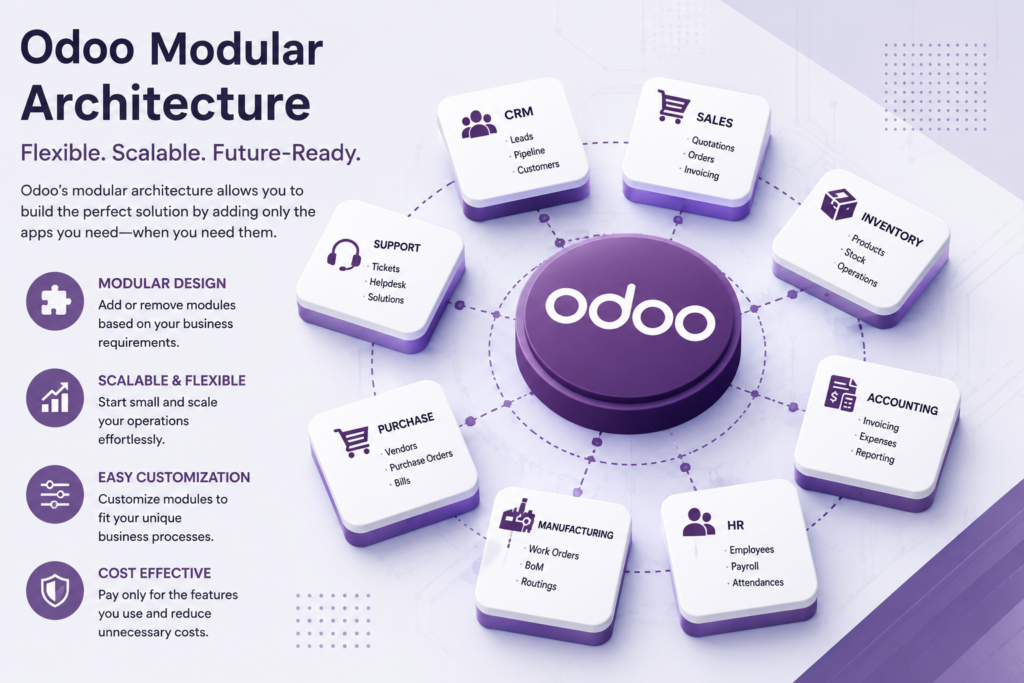
The exact same principle is the absolute foundation of Odoo Modular Architecture in the commercial world. The software ecosystem consists of more than forty core official applications and thousands of specialized industry tools that exist as independent functional modules. Each module is carefully programmed to handle one specific business function with maximum efficiency. For example there is a dedicated module for sales invoicing inventory point of sale manufacturing project management and human resources.
When a small enterprise launches its digital transformation journey utilizing Odoo Modular Architecture they simply activate the exact modules that solve their most pressing operational pain points today. The software core framework acts as a central nervous system while the individual applications plug directly into that framework. Because every module shares a single unified relational database you never have to enter the same piece of information twice. When you add a new module six months or two years later it seamlessly connects with your existing setup instantly recognizing your historical customer profiles product catalogs and financial ledgers without requiring expensive database migrations or manual coding workarounds.
Traditional Software Versus Modular Layout Comparison
| Feature Category | Traditional Monolithic ERP Suites | Modern Modular Setup | Your Direct Business Benefit |
| Upfront Cost | Extremely high mandatory capital licensing | Pay only for activated modules | Keeps initial IT budget manageable |
| System Speed | Slow and bloated with unused features | Blisteringly fast and lightweight | Boosts daily employee productivity |
| Implementation | Takes twelve to twenty four months | Deployed within two to four weeks | Eliminates long operational downtime |
| Scalability | Rigid and penalized with extra fees | Seamless click to install expansion | Grows naturally alongside your company |
| User Training | Confusing screens overflowing with data | Clean tailored role based interfaces | Ensures high employee adoption rates |
Why Odoo Modular Architecture Is The Ultimate Solution For Small Enterprises
Small enterprises operate under strict financial constraints and tight operational timelines. They simply cannot afford to freeze their daily business operations for six months while IT consultants configure complicated software systems. Let us examine the concrete operational and financial reasons why Odoo Modular Architecture has become the preferred choice for growing enterprises worldwide.
- Complete Elimination Of Software Bloat And System Sluggishness: Traditional enterprise software is notorious for software bloat. When you install a monolithic system your server is burdened with thousands of background processes database tables and complex screens that your employees will never touch. This unnecessary clutter confuses staff members slows down screen loading speeds and requires expensive computer hardware just to run basic daily operations. Because Odoo Modular Architecture allows you to install only what you actually need your software environment remains lightweight blisteringly fast and exceptionally user friendly. Your accounting team only sees accounting screens and your warehouse staff only sees inventory management tools which keeps daily productivity at an absolute maximum.
- Drastic Reduction In Upfront Financial Risk: Investing capital into software that your team might fail to adopt is a major fear for small business owners. Traditional software providers demand massive upfront licensing fees for their entire suite regardless of whether you use ten percent or one hundred percent of the features. With Odoo Modular Architecture your financial expenditure is tied directly to the value you receive. You can launch your digital journey by investing in a single application subscription. Once that first module demonstrates a clear return on investment by saving labor hours and eliminating administrative errors you can confidently reinvest those savings into activating your second and third modules.
- Frictionless Employee Adoption And Zero Disruption: Human beings naturally resist massive sudden changes to their daily work routines. When you force employees to learn an entire multi departmental software suite overnight employee morale drops and operational mistakes multiply. Modularity solves this human challenge by enabling a gentle phased onboarding process. You can train your sales team on the customer relationship management module this month without disturbing your warehouse or accounting departments. Once the sales team is completely comfortable and excited about their new automated tools you can introduce the inventory module to the warehouse team next month. This structured phased onboarding guarantees an exceptionally high employee adoption rate across your entire company.
Essential Building Blocks Within The Odoo Modular Architecture
To understand how you can construct your customized corporate ecosystem let us explore the core applications that form the backbone of Odoo Modular Architecture for growing small businesses. Each of these modules functions brilliantly as a standalone tool while offering limitless power when integrated together.
Sales And Customer Relationship Management
For most small businesses revenue generation is the primary focus. The customer relationship management and sales modules within Odoo Modular Architecture provide a complete digital sales funnel.
- Your sales representatives can track prospective leads from social media campaigns email inquiries and website visits on a clean visual pipeline.
- When a client requests a price quotation your salesperson can generate a beautifully formatted digital quotation in seconds with just a few clicks.
- Once the customer approves the quote online the module automatically converts it into a confirmed sales order without requiring any manual data re entry.
Invoicing And Financial Accounting Integration
Managing cash flow accurately is what keeps a small business alive. When you activate the invoicing and accounting applications within Odoo Modular Architecture your financial management becomes completely automated.
- The instant a sales order is confirmed by your sales team the system automatically generates a draft tax invoice for your accountants to review.
- The accounting module handles complex local Pakistani tax calculations withholding tax rules and multi currency transactions effortlessly.
- Because it connects natively with local banking channels your financial controllers can reconcile daily bank statements with customer invoices in a matter of minutes rather than hours.
Inventory And Warehouse Management Operations
For small wholesale distributors and retail shop owners losing track of physical stock is a costly nightmare. The inventory module operates within Odoo Modular Architecture using advanced double entry stock tracking principles.
- Every item entering moving within or leaving your warehouse is recorded with complete mathematical precision.
- You can set up smart automated reordering rules that monitor your stock levels continuously.
- When a popular product drops below your defined safety threshold the system automatically creates a purchase request alerting your procurement team to order fresh stock before you ever experience an out of stock situation.
Purchasing And Supplier Relationship Management
Buying raw materials or trading goods at the right price and time is essential for maintaining strong profit margins. The purchase management tool inside Odoo Modular Architecture streamlines your entire procurement process.
- You can send requests for quotations to multiple suppliers simultaneously and compare incoming vendor pricing on a clean dashboard.
- Convert the winning bid into a formal purchase order with one click.
- Once the vendor delivers the goods to your warehouse the receiving staff checks the items against the original purchase order ensuring you only pay for the exact quantities and quality you actually received.
Human Resources And Employee Payroll Management
As your small business grows managing staff attendance leave requests and monthly salaries on paper clipboards becomes impossible. The human resource suite within Odoo Modular Architecture digitizes your entire workforce management.
- Employees can log their daily attendance through biometric hardware or mobile applications and submit digital leave requests for managerial approval.
- Your staff can easily download their monthly salary slips online from a secure employee portal.
- The automated payroll engine calculates basic salaries variable overtime hours loan deductions and local tax withholdings flawlessly saving your HR department days of tedious administrative calculation at the end of every month.
Operational Pro Tip: Connect your sales and inventory modules first. This automatically reserves physical stock the moment a online sales quote is signed preventing embarrassing overselling and customer cancellations.
How Odoo Modular Architecture Eliminates Data Silos Across Your Business
The greatest operational tragedy in modern small business management is the existence of data silos. A data silo occurs when different departments use disconnected software tools that cannot communicate with one another. For example your retail store might use a stand alone point of sale program your warehouse might track inventory on an Excel spreadsheet and your accountant might use separate accounting software. In this fragmented setup when a customer purchases the last item in your store the warehouse staff has no idea the stock is gone and the accountant has to manually type the paper receipt into their ledger at the end of the week.
This manual copying and pasting of data between disconnected systems wastes valuable labor hours and introduces frequent human typing mistakes. A single misplaced zero on an invoice or a forgotten spreadsheet update can cost your business thousands of rupees in lost revenue and inventory shrinkage.
The true genius of Odoo Modular Architecture lies in its unified relational database structure. Unlike traditional software setups where you have to buy expensive third party integration middleware to connect different programs every module here is natively built to talk to the others. When you add a new module to your Odoo Modular Architecture setup it immediately taps into the central data pool.
How Data Flows Automatically Across Departments
- The Online Checkout: A customer visits your e commerce website and purchases five units of a commercial product.
- Instant Stock Reservation: The checkout module instantly alerts the inventory module to reserve five units in your physical warehouse so no one else can buy them.
- Automated Accounting Ledger: Simultaneously the system informs the finance module to generate a payment receipt and record the incoming corporate revenue.
- Warehouse Dispatch Notification: Next the warehouse module prints a shipping label and alerts the packing staff to dispatch the goods immediately.
- Customer Tracking Email: Finally once the courier scans the package the system sends an automated tracking email to the customer without a single human typing a message.
Every single step happens automatically in real time without a single human being manually copying data from one screen to another. This is the ultimate power of a truly unified modular architecture.
Step By Step Growth Roadmap Using Odoo Modular Architecture
One of the most frequent questions small business owners ask is how they should actually plan their digital transformation journey over time. Because Odoo Modular Architecture gives you total control over what you install and when you install it you can design a strategic growth roadmap that matches your business expansion goals. Here is a proven three phase implementation roadmap utilized by highly successful small enterprises in twenty twenty six.
Phase 1: Establishing The Operational Foundation (Months 1 To 3)
During your first two to three months of digital adoption your sole focus should be getting your core commercial transactions under complete control. In this foundational phase you should activate only the sales invoicing accounting and basic inventory modules. This lean setup allows your team to abandon paper invoicing and spreadsheets completely. Your staff will master digital quotation generation real time stock checking and automated bank reconciliation. By keeping phase one simple you ensure rapid employee adoption and immediately stabilize your daily cash flow management.
Phase 2: Expanding Into Supply Chain And Automation (Months 4 To 6)
Once your team is comfortably running daily operations on your foundational setup usually around month four to six you can begin expanding your technological footprint. During phase two you should activate the purchase management supplier portal and customer relationship management modules. This expansion automates your stock reordering rules connects your procurement team directly with trusted vendors and gives your sales team advanced tools to nurture marketing leads. Your operational efficiency will increase dramatically as manual purchasing tasks disappear.
Phase 3: Achieving Advanced Enterprise Intelligence (Year 2 And Beyond)
As your business enters its second year and your revenue multiplies you can unlock the most advanced capabilities of your software ecosystem. In phase three you can activate complex modules like factory manufacturing quality assurance human resources automated payroll and executive analytical dashboards. Because your foundational data from phase one and two is already sitting cleanly inside the database activating these advanced tools requires minimal configuration. Your managing directors and department heads will gain instant access to real time business intelligence allowing you to make rapid data driven decisions that outpace your market competitors.
Frequently Asked Questions About Odoo Modular Architecture
Find direct transparent answers regarding system scalability application integration pricing structures and technical maintenance to help you make an informed commercial decision for your small business.
- What exactly is Odoo Modular Architecture and how does it differ from traditional software suites?It is an intelligent software design where an enterprise resource planning platform is broken down into independent functional applications or modules such as accounting inventory sales and human resources. Unlike traditional software suites that force you to buy and install a massive rigid bundle of programs you will never use Odoo Modular Architecture allows you to install only the specific applications your business needs today while sharing a single unified database.
- Can a small business really start with just one single module and add more later?Absolutely without exception. One of the greatest financial and operational advantages of this architecture is the ability to start small. A local retail store or startup can begin by installing only the invoicing or inventory module on day one. Six months or two years later as the business expands and generates more profit you can activate additional modules like CRM or manufacturing with a single click without losing any of your historical data.
- Will adding new modules later disrupt our daily business operations or slow down our server?No adding new applications causes zero operational disruption. Because every official application is built upon the same underlying framework and shares the same relational database activating a new module simply unlocks new screens and features for your users. Your historical customer records product catalogs and financial ledgers are instantly recognized by the newly added module keeping server performance blisteringly fast and stable.
- How does Odoo Modular Architecture help small businesses control their IT implementation budget?By allowing you to adopt a pay as you grow financial model. With Odoo Modular Architecture you never have to spend capital on complex features your employees do not need. You save thousands of rupees in upfront software licensing and consulting fees by launching a lean foundational setup first. Once that initial setup generates tangible labor savings you can reinvest those operational profits into expanding your digital ecosystem over time.
- Do we need to hire a full time IT department to manage a modular software system?No small businesses do not need a dedicated internal IT department to operate this platform. When hosted on secure cloud infrastructure system updates automated daily backups and server security patches are handled automatically in the background. By partnering with an experienced implementation agency for initial configuration and occasional technical support your regular business staff can manage daily operations easily.
Ready To Scale Your Small Business Today
Stop letting messy spreadsheets disconnected software tools and operational chaos hold your small business back from achieving its true growth potential in twenty twenty six. The modern commercial world rewards agility financial clarity and seamless automation above all else. By embracing a modular software strategy you gain the absolute freedom to modernize your enterprise at your own pace without risking your operational budget or overwhelming your hardworking staff.
To transform your daily corporate operations with seamless automation and absolute zero data loss visit our website today Kaspar Consulting Services and Odoo pages